
An Interview with Solar Citizens – Australia’s Leading Voice for Clean, People-Powered Energy
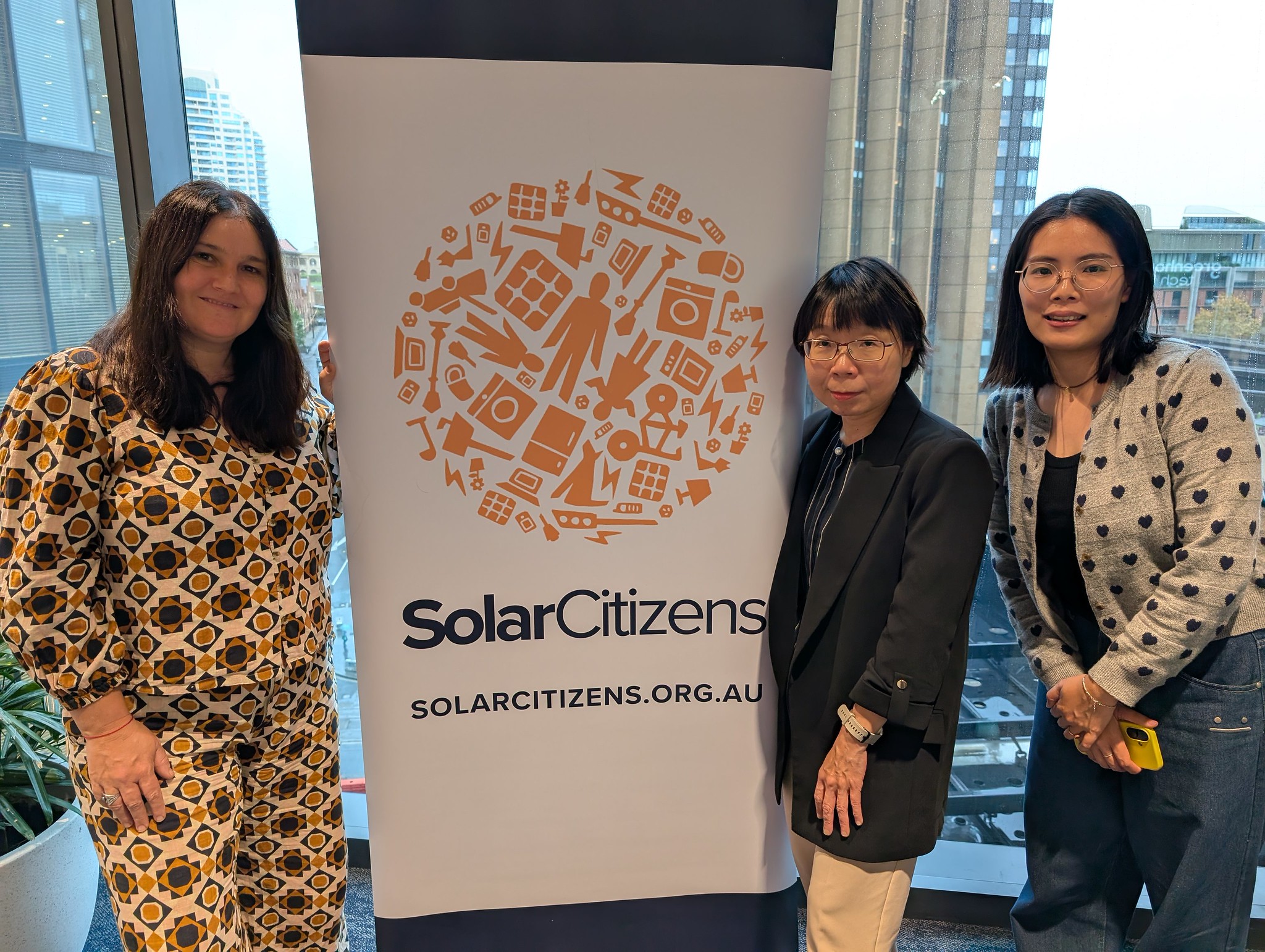
As countries across the globe wrestle with how to decarbonise their energy systems and empower citizens in the transition, few have embraced the grassroots power of rooftop solar quite like Australia. To better understand the opportunities and challenges of citizen-led energy transformation, Jessie (Wentzu) and Min-Hui from Environmental Information Center (Taiwan) spoke with Solar Citizens, a leading Australian advocacy organisation working to ensure that everyday people—not just energy giants—benefit from the clean energy transition. Solar Citizens also arranged for EIC to speak to Ken Enderby, as a local case study of an “electrified Australian”.
Environmental Information Center (EIC) is a leading nonprofit environmental news platform based in Taiwan, covering topics such as environmental policy, climate action, biodiversity, and sustainable development. You can learn more about EIC at https://e-info.org.tw.
The Right to Solar – Not Just for Homeowners
Environmental Information Center: In Australia, electricity bills are a major burden. Solar Citizens often talks about the “right to solar”—what does this mean in practice?
Solar Citizens: Having a “right to solar” captures the idea that access to bill-lowering, climate-friendly technology shouldn’t depend on whether you own your home. Our advocacy focuses on fixing the policy failures that exclude millions of renters, apartment dwellers, and social housing residents from accessing solar and battery savings.
Environmental Information Center: If a landlord installs solar panels, do tenants actually benefit?
Solar Citizens: Generally, yes—tenants pay the electricity bills, so they get the savings. But landlords may be reluctant to invest because they don’t directly benefit. This is what’s called a “split incentive.” We are exploring a carrot and stick approach - incentives and penalties for landlords to drive uptake of solar on rental properties.
But Australia currently lacks compulsory minimum energy efficiency standards for rental homes, and responsibility for energy efficiency is with state governments, whereas tax rebates for landlords' investments is with the federal government, making coordinated reform a challenge. In apartments, physical and legal barriers—like outdated strata laws—add complexity.
Household Batteries vs “Community-Washed” Network Batteries
Environmental Information Center : You’ve said you support behind-the-meter (household) batteries more than so-called “community batteries.” Why?
Solar Citizens: Household batteries give power—literally and financially—back to the people. Because they’re installed on-site, consumers avoid paying network charges. They own the asset and reap the bill savings. Most “community batteries” in Australia are actually owned by large energy networks, not communities. The government’s 2021 rollout of 400 “community batteries” was largely a case of branding corporate-owned infrastructure as grassroots.
Environmental Information Center: So why did the government choose this path?
Solar Citizens: It was about speed and scale. They thought large batteries are easier to deploy quickly, and governments were under pressure to act during an energy and cost-of-living crisis. But they missed an opportunity to back genuine, citizen-led solutions.
Public Misunderstanding of “Community” Solutions
Environmental Information Center: Surveys show Australians support community batteries. Could this be due to confusion?
Solar Citizens: Absolutely. Many people equate the term with community-owned solar farms—projects where benefits stay local. If “community batteries” followed this model, we’d be all for it. There are a few promising pilots in places like Noosa in Queensland and the NSW South Coast, but they’re rare.
There’s growing interest in new technologies, like Solshare, which could enable shared battery use in apartment complexes—something we’re watching closely.
Negative Pricing and the Battery Boom
Environmental Information Center : Australia is seeing “world-leading negative electricity pricing,” especially in states like Victoria and South Australia. How does this impact solar?
Solar Citizens: Negative pricing makes it harder to get good returns from solar exports. That’s why we’ve seen the introduction of solar export charges and falling feed-in tariffs.
But it’s also driving demand for batteries—both at the grid and household level. What we haven’t seen enough of is innovation in demand response—shifting when we use power to match when it’s available.
Environmental Information Center: Could negative pricing actually help the transition?
Solar Citizens: Not really. It might make the system more “rational” on paper, but it discourages investment. We need smart policies and targeted incentives, especially to help low-income households participate in the energy shift.
What People Really Care About
Environmental Information Center: After years of promoting rooftop solar, what concerns come up most from the public?
Solar Citizens: People worry about losing control of their energy investment, about the safety and recyclability of batteries, and they often distrust energy companies. That’s why Virtual Power Plants (VPPs) have been slow to take off—people don’t want to hand back control after gaining it.
Environmental Information Center: What works when promoting solar?
Solar Citizens: Simple: bills and control. When people see solar as a way to cut costs, gain independence, and protect themselves from price shocks, they’re sold. Plus, once installed, people become far more energy-literate—they track their usage, shift their habits, and become active players in the system.
A Model for the World?
Environmental Information Center: Australia has four million rooftop solar systems, and counting. What can other countries learn from Australia?
Solar Citizens: The biggest lesson is that the transition doesn’t have to come from the top down. Tapping into household capital and motivation can unlock a massive wave of clean energy investment.
It’s also about personal power—shifting it from big utilities to households. And once people are directly involved, they become the transition’s strongest advocates.
Post-Election Energy Outlook
At the time of the interview, Australia’s political direction on energy was still being shaped by federal election results. Solar Citizens noted a growing shift toward supporting household-level clean energy, including a new federal rebate for batteries, which Solar Citizens campaigned for for three years and was implemented on July 1 2025 as the Cheaper Home Batteries Program. But they warned that continued pressure from citizens would be essential to keep governments honest and focused on fair, effective solutions—not just big-ticket industry subsidies.
The full article series was published on August 1st. You can find all the articles here: https://e-info.org.tw/taxonomy/term/51145
The quotes and insights Solar Citizen provided appear in the following articles:
https://e-info.org.tw/node/241585
https://e-info.org.tw/node/241615
https://e-info.org.tw/node/241744
https://e-info.org.tw/node/241830