Latest reports on Australia’s energy network reveal that, contrary to what we’ve been told, there’s a huge amount of untapped consumer energy potential that won’t add extra costs to the local transmission network. Philippa England reports in this article first published in Fifth Estate on 22 July.
The latest Clean Energy Australia Report for 2025 confirms rooftop solar continues to lead the transition to renewable energy in Australia. [1]
Of the 5.2 gigawatts (GW) of renewable generation capacity added in 2024, 3.2 GW was rooftop solar. That means Australian solar homes contributed more than 60% of Australia’s new renewable energy generation capacity in 2025.
This should come as no surprise given rooftop solar has led the growth in renewable energy capacity every year since 2019.
2024 was the fifth year in a row that Aussie homes installed more than 300,000 new rooftop solar arrays. Our total installed rooftop capacity now weighs in at 25 GW of installed capacity - that’s more than the power generated by all black and brown coal-fired power stations combined.
Australian solar homes contributed more than 60% of Australia’s new renewable energy generation capacity in 2025.
In 2024, our rooftops accounted for 31% of all renewable energy generated and 12.4% of all electricity in the National Electricity Market (NEM) - and that’s not including all the solar power we’re directly using in our homes.
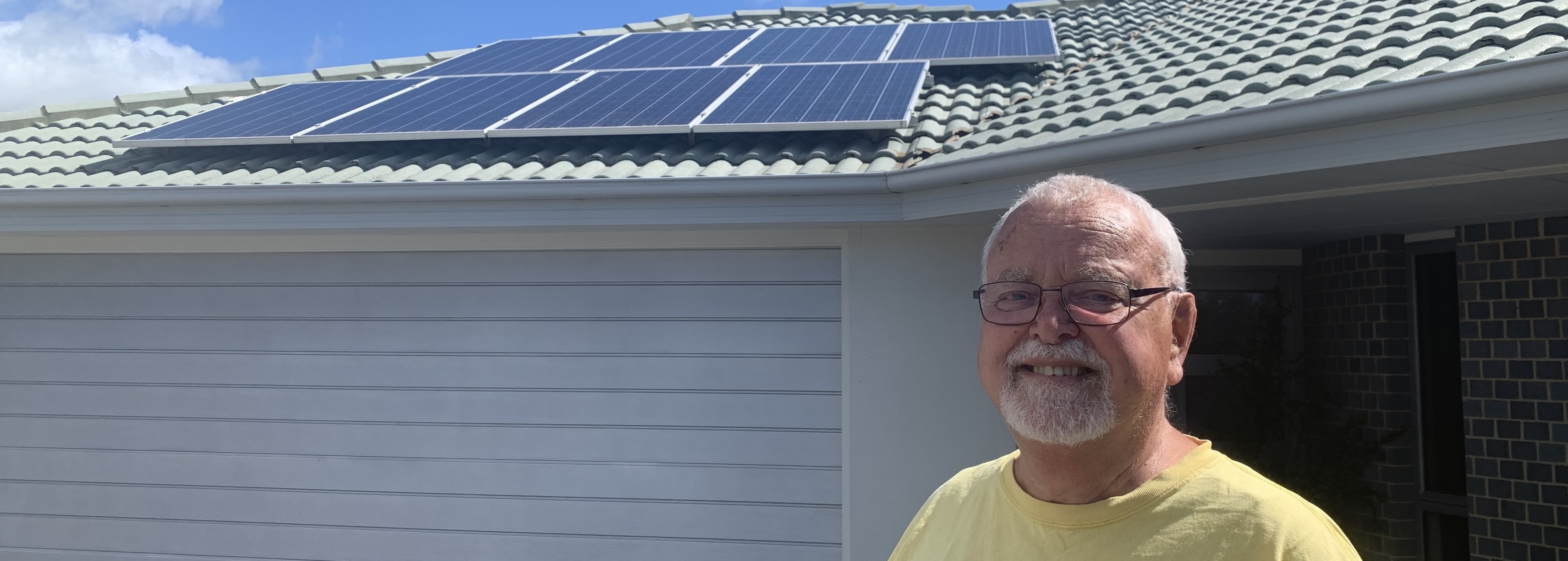
We now have more than 4 million rooftop solar arrays sitting on Australian homes and small businesses. Kudos to Queensland for being the first state in the country to pass the 1 million mark. But New South Wales is rapidly catching up and it too now has over one million solar rooftops. It’s amazing what a comprehensive Consumer Energy Resources strategy (CER) can do for rapid uptake of distributed CER resources. [2]
But Australia has even more rooftop solar potential - a 2024 Solar Citizens report found there is more than 60 GW of potential capacity for rooftop solar on our existing housing stock. [3] Even more surprisingly, an aptly titled report ‘How much rooftop solar can be installed in Australia?’ prepared for the Clean Energy Finance Corporation and the Property Council of Australia in 2019 identified 179 GW of solar potential on our rooftops once we include large commercial, industrial and other rooftops. [4] Those large rooftops could generate an annual energy output of 245 terawatt-hours. That’s equivalent to about two thirds of the total anticipated capacity of the NEM in 2050.
But there’s even more good news to report. The 2025 draft Electricity Network Options Report, published by the Australian Energy Market Operator (AEMO) identifies a huge amount of untapped potential for ongoing CER development in the low voltage, distributed network - (ie connecting the energy generated by our homes and workplaces together.) [5]
For the first time it has attempted to calculate the potential of this critical piece of the transmission grid - and the numbers are inspiring.
According to AEMO’s calculations we could add more than 57 GW of rooftop solar/stored battery power to our local grids - at little to no extra transmission cost for the grid. How’s that for bringing down the cost of transmission!
AEMO has identified some simple low cost measures that could unlock this potential capacity such as: dynamic operating envelopes; dynamic voltage management systems; offload tap optimisation and load shifting tariffs [6] Interestingly, community or grid connected (in front of meter) batteries are listed as a high cost option and are not favoured in this review.
So is anyone working on unlocking all this extra rooftop capacity? Hats off to the Committee for Sydney who’s recently published report - Sydney as a Renewable Energy Zone which finds that up to 75 per cent of metropolitan Sydney’s annual energy needs could be met if every rooftop had solar panels. [7] Their report invites us to imagine a “A metropolis of energy equity, affordability and abundance” where “the sun powers not just our homes, but our buses, our businesses,and our neighbourhoods”.
Further reading
CEC, Clean Energy Australia Report, 2025
Solar Citizens, Rooftop Solar Potential report, 2024
AEMO, Draft 2025 Electricity Network Options Report
Committee for Sydney, Sydney as a Renewable Energy Zone, 2025
NOTES
1] Clean Energy Australia Report, 2025 Clean Energy Council, May 2025
2] NSW Consumer Energy Resources Strategy, Department of Climate Change, Energy, The Environment and Water, September 2024
3] Rooftop Solar Potential by tenure and dwelling type, Solar Citizens April 2024
4] How much rooftop solar can be installed in Australia?, Clean Energy Finance Corporation & Property Council of Australia, 2019
5] Draft 2025 Electricity Network Options Report May 2025, Australian Electricity Market Operator
6] ibid p188-89
7] Sydney as a Renewable Energy Zone, Committee for Sydney, June 2025