The Net Zero Commission is consulting with the public to inform key recommendations to ensure the NSW Government achieves a 50% reduction in greenhouse gas emissions by 2030 and 70% by 2035, compared to 2005 levels. Our National Campaigner Charlie Rodrick writes that we need to see urgent action on emissions reduction in the built environment as this is the worst performing sector in data released by the Net Zero Commission. This article was first published in The Fifth Estate.
The truth is that the Minns Government is not on track to achieving legislated emissions reduction targets and according to the NSW Net Zero Commission, urgent action is required within this term of government to address this shortfall, especially in relation to the 2030 and 2035 targets.
The NSW Net Zero Commission, established just last year, is an independent body of experts tasked with a) assessing the state’s progress to meeting targets, and b) recommending ways to accelerate progress, across all areas of government.
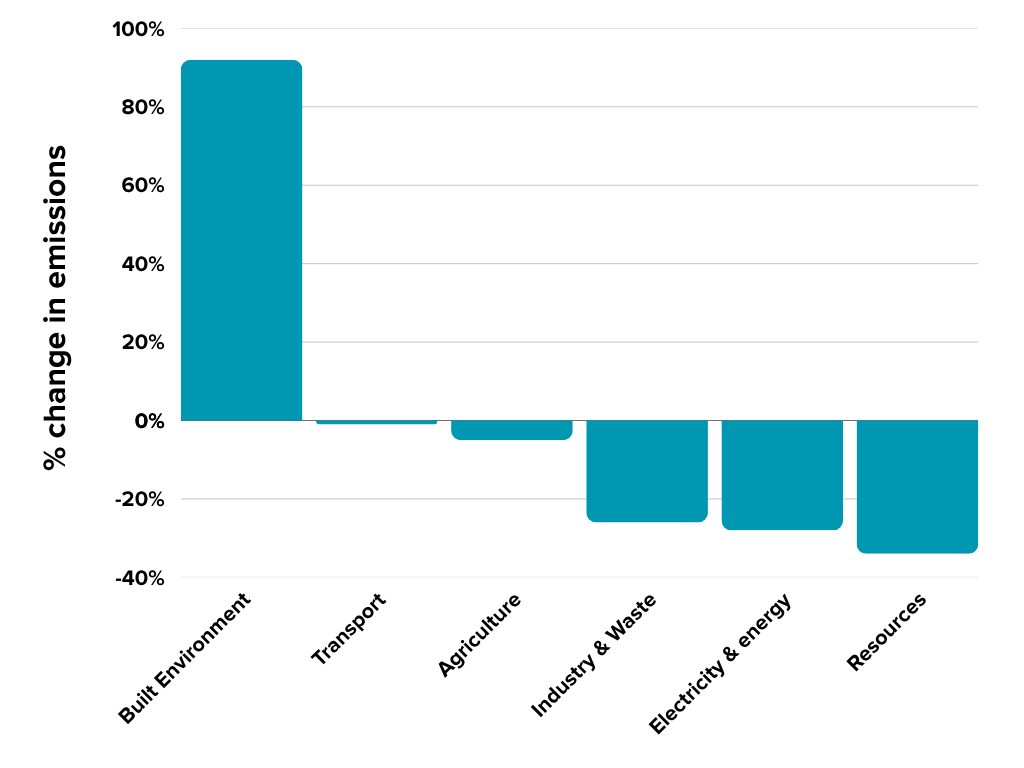
Built environment sector the weak link, where emissions have almost doubled since 2005
The 2024 Annual Report found that progress towards Net Zero had not been uniform across all sectors - and while the electricity and energy sector saw a 28% decline since 2005 thanks to more renewables in the grid, greenhouse gas emissions in the built environment sector actually increased by 92% within this same time period. [1]
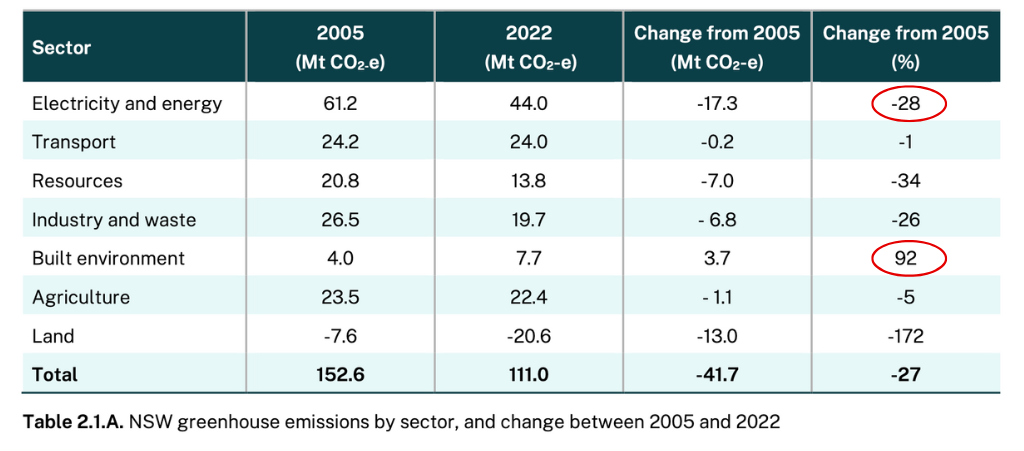
The electricity sector is still the largest contributor to greenhouse emissions, although considerable progress has been made in recent decades thanks to the increasing amount of renewable energy in the grid - with rooftop solar making up a considerable portion of this generation.
The commission states in its Annual Report that ‘the rapid decarbonisation of the electricity and energy sector is critical to NSW achieving its emissions reductions targets’ [1a]. The biggest risk to this is the possible further extension of Eraring - Australia’s largest coal-fired power station at a whopping 2,880 MW capacity. The station’s closure date has already been delayed once to August 2027, and any further extension will risk missing the legislated emissions reduction targets.
NSW Energy and Climate Change Minister Penny Sharpe recently committed to develop a new Net Zero plan, and has called for a "redoubling of effort" in direct response to the findings of the commission's annual report. [2] However we are yet to see any serious commitment from the rest of government, including the Planning and Transport Ministers who hold substantial influence over the worst-performing sectors.
With the NSW Government set to deliver 377,000 new homes by 2030 (including up to 60,000 apartments by 2027 under the Transport Oriented Development (TOD) Program), [2][3] it is imperative to get the right policies in place as soon as possible, and avoid locking in decades of carbon emissions and high energy bills for the residents of these new homes.
What will it take for the built environment sector to meet emissions reduction targets?
We now have an opportunity to provide input into how the NSW government decides on pathways that will reduce greenhouse emissions, through the public submission process to the Net Zero Commission.
The Net Zero Commission identified in the annual report that a mandatory electrification policy for new developments would be highly effective in reducing carbon emissions. Gas bans have already been introduced by the Victorian Government and five NSW councils, and have gained broad support from councils, industry, social services, community organisations and climate and health alliances.
Despite the numerous arguments for a ban on gas - spanning public health, cost of living and climate change - Premier Chris Minns and Planning Minister Paul Scully have made it clear on multiple occasions that they would not support such a policy.
Accelerating rooftop solar plus battery storage
In addition to introducing a ban on gas appliances, the NSW Government must ensure that new homes are net zero ready, with clean energy generation and storage capacity to support the grid. Installing a 3.3 kW solar system on all 377,000 new homes set to be built by 2030 would contribute a total renewable energy generation capacity of 1.24 GW - almost half of the electricity capacity of Eraring coal-fired power station.
The full emissions reduction potential of rooftop solar is realised when paired with behind-the-meter battery storage; when used to power electric appliances such as heat pump hot water and induction stovetops, and when households swap out petrol and diesel for an electric vehicle fuelled by sunshine.
In addition to the above recommendations, Solar Citizens is calling for the NSW Government to:
-
Support renters by introducing Minimum Energy Efficiency Standards, alongside rebates, loans or other incentives to drive rooftop solar uptake
-
Commit to ambitious targets to electrify and decarbonise all social housing in NSW, with rooftop solar and battery storage connected to VPPs
-
Continue to support strata and apartments with policies and funding - especially hard-to-retrofit buildings like high rise apartments
- Investigate Urban Renewable Energy Zones (UREZs) and unlock the significant rooftop solar potential of NSW’s commercial & industrial rooftops, backed up by small and medium-scale battery storage
Anyone can put in a submission to the Net Zero Commission including individuals and organisations. Submissions are due by 12pm this Friday 11 July, and must be made via the Net Zero Commission’s website here.
Published in The Fifth Estate as "Our chance to help the Net Zero Commission get NSW back on track", 8 July, 2025
Read Solar Citizens’ submission here.
[1] Net Zero Commission Annual Report, November 2024
[1a] NZC Annual Report, p11
[2] Ministerial Statement - Net Zero Plan, May 2024